
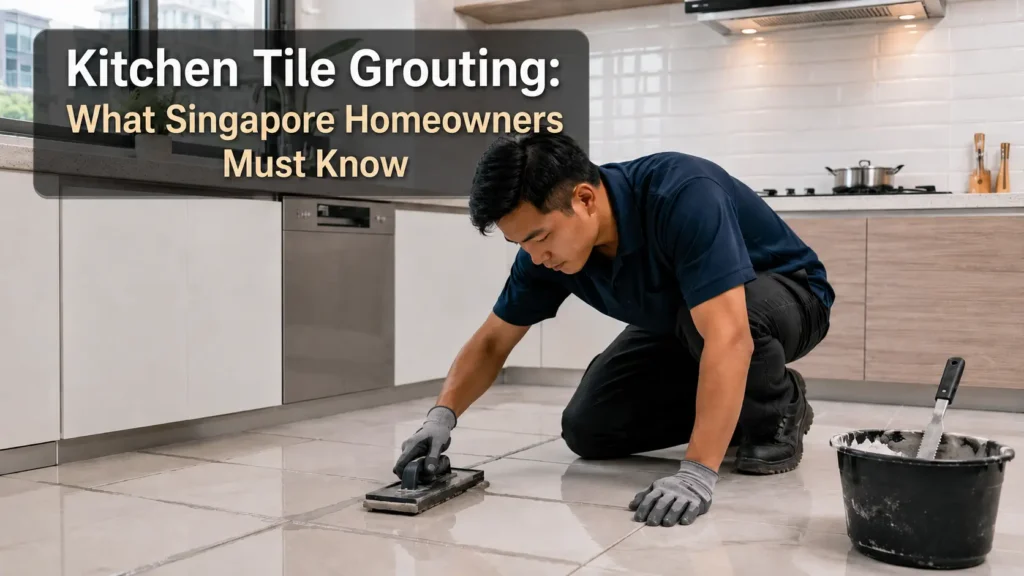
Kitchen tile grouting in Singapore is important because kitchens deal with water, oil, food stains, heat, and humidity every day. Good grout protects the gaps between your tiles, keeps your kitchen cleaner, and helps prevent mould, stains, and water damage.
If your kitchen grout is cracked, black, loose, or hard to clean, it may be time to repair or replace it. For many HDB flats, condos, and landed homes in Singapore, proper kitchen tile grouting can improve hygiene, safety, and the overall look of the kitchen.
This guide explains what kitchen tile grouting is, why it matters in Singapore homes, how much it may cost, what problems to look for, and when to call a professional.
What Is Kitchen Tile Grouting?
Kitchen tile grouting is the process of filling the gaps between tiles with grout.
Grout is the line you see between each tile. It may look like a small detail, but it plays an important role. It helps keep dirt, water, grease, and food waste from getting into the gaps between tiles.
In a kitchen, grout has to handle many things every day, such as:
- Water from the sink
- Cooking oil
- Food spills
- Steam
- Floor washing
- Cleaning chemicals
- Heavy foot traffic
When grout is done properly, your kitchen is easier to clean and maintain. When grout is damaged, your kitchen can look dirty even after cleaning.
Why Kitchen Tile Grouting Matters in Singapore
Singapore homes face a few local conditions that make kitchen grout very important.
The weather is warm and humid. Many kitchens are compact. Many families cook daily. These factors can make grout lines stain, darken, or grow mould faster.
This is common in HDB kitchens, condo kitchens, resale flats, and older homes across Singapore.
Singapore Kitchens Often Stay Moist
Kitchen areas near the sink, floor trap, washing machine, and wet kitchen zone often stay damp. If the grout is old or porous, it can absorb moisture.
Over time, this can lead to:
- Black grout lines
- Mould growth
- Bad smell
- Stains that keep coming back
- Weak or missing grout
This is why the right grout material matters.
Small Kitchen Layouts Can Make the Problem Worse
Many HDB and condo kitchens in Singapore are not very large. The stove, sink, washing area, and cabinets may be close together.
Because of this, one section of the kitchen may get exposed to oil, water, heat, and cleaning products every day.
If the grout is not strong enough, it may wear out faster.
Common Kitchen Grout Problems in Singapore Homes
Kitchen grout problems usually start small. But if you ignore them, they can become bigger and more expensive to fix.
Here are the most common issues Singapore homeowners face.
1. Black Grout Lines
Black grout lines are very common in Singapore kitchens.
They may be caused by:
- Mould
- Dirt
- Cooking oil
- Water stains
- Old cement grout
- Poor ventilation
For example, a homeowner in Tampines may notice black grout near the kitchen sink. Even after scrubbing, the black marks return. This often means the grout is absorbing moisture, not just dirty on the surface.
2. Cracked Grout
Cracked grout can happen when the grout is old, weak, or poorly installed.
It can also happen when tiles move slightly over time. Once grout cracks, water can enter the gaps between tiles.
This may lead to loose tiles or hollow tiles.
3. Missing Grout
Missing grout creates open gaps between tiles. These gaps collect water, food waste, and dirt.
This is not only unattractive. It can also become unhygienic.
If grout is missing from your kitchen floor, avoid heavy washing until it is fixed. Water may enter the gaps and make the problem worse.
4. Greasy Grout Near the Stove
Kitchen backsplash grout often turns yellow or brown because of cooking oil.
This is common in homes where frying or heavy cooking is done often. Oil can settle into porous grout and become difficult to remove.
5. Mould That Comes Back After Cleaning
If mould keeps coming back, the problem may not be surface dirt.
The grout may be too porous. The area may also be too damp. In this case, normal cleaning will only give short-term results.
Regrouting may be the better solution.
Cement Grout vs Epoxy Grout for Singapore Kitchens
Not all grout is the same. The two common options are cement grout and epoxy grout.
Choosing the right one can affect how long your kitchen grout lasts.
What Is Cement Grout?
Cement grout is a traditional grout material. It is often used because it is affordable and easy to apply.
Pros of Cement Grout
- Lower cost
- Easy to find
- Suitable for basic tile work
- Common in many older homes
Cons of Cement Grout
- More porous
- Can absorb water
- Can stain more easily
- May need sealing
- May grow mould faster
- May need more maintenance
Cement grout can work in some areas. But in kitchens, especially wet or busy kitchens, it may not last as well.
What Is Epoxy Grout?
Epoxy grout is a stronger grout material. It is made to resist water, stains, and dirt better than normal cement grout.
Pros of Epoxy Grout
- Strong water resistance
- Better stain resistance
- Easier to clean
- Better for kitchens
- Better for wet areas
- More durable
- Less likely to absorb oil and dirt
Cons of Epoxy Grout
- Higher cost
- Needs skilled installation
- Harder to apply than cement grout
- Poor installation may leave grout haze
For many Singapore kitchens, epoxy grout is a better long-term choice.
Which Grout Is Better for Kitchen Tiles?
For kitchen tile grouting in Singapore, epoxy grout is often better because it handles water, stains, and daily cleaning more effectively.
Cement grout may be cheaper at first. But it may stain, crack, or grow mould faster.
A simple rule is this:
If your kitchen gets wet often, has heavy cooking, or has grout that keeps turning black, epoxy grout may be the better option.
Kitchen Tile Grouting Cost in Singapore
The cost of kitchen tile grouting in Singapore depends on several factors. There is no one fixed price for every home.
A small HDB kitchen will not cost the same as a large landed home kitchen. A simple grout touch-up will also cost less than full epoxy regrouting.
What Affects the Cost?
The final cost may depend on:
- Kitchen size
A larger kitchen needs more material and more labour. - Type of grout
Epoxy grout usually costs more than cement grout. - Condition of old grout
If old grout must be removed, the job takes more time. - Tile size
Small tiles have more grout lines, so they take longer to work on. - Floor or wall area
Grouting only the floor may cost less than grouting the floor and backsplash. - Tile condition
Loose or hollow tiles may need repair before grouting. - Access and work rules
Some condos have work-hour rules, lift protection rules, and contractor access rules.
Why Cheap Grouting May Cost More Later
A very cheap quote may not include proper preparation.
Poor grouting can lead to:
- Uneven grout lines
- Early cracking
- Grout haze
- Stains returning quickly
- Mould coming back
- Loose tiles
It is better to ask what is included before choosing a contractor.
Ask these questions:
- What grout material will you use?
- Will you remove the old grout?
- Will you clean the joints first?
- Is epoxy grout suitable for my kitchen?
- How long does the grout need to cure?
- Are loose tiles included in the quote?
- Is cleanup included?
A clear quote helps you avoid problems later.
HDB, Condo, and Landed Kitchen Grouting in Singapore
Different home types need different planning.
HDB Kitchen Tile Grouting
HDB kitchens are used daily by many families. They often deal with cooking oil, water splashes, and frequent floor cleaning.
Common HDB kitchen grout problems include:
- Black grout near the sink
- Cracked grout near the floor trap
- Stains near the stove
- Old grout in resale flats
- Loose tiles in older units
If you live in an HDB flat in Tampines, Bedok, Toa Payoh, Yishun, Woodlands, Jurong, Punggol, or Sengkang, regrouting may help refresh your kitchen without replacing all the tiles.
Condo Kitchen Tile Grouting
Condo kitchens may need extra planning. Some condos have management rules for renovation work.
Before arranging grouting work, check:
- Work hours
- Contractor registration
- Lift protection
- Noise rules
- Access approval
This is common in condos in areas such as River Valley, Orchard, Novena, Queenstown, Marine Parade, and Bukit Timah.
Landed Home Kitchen Tile Grouting
Landed homes may have larger kitchens or wet kitchens. Some may also have outdoor cooking areas.
These kitchens may need stronger grout because they handle more water and heavier use.
For landed homes in Serangoon, East Coast, Bukit Timah, Upper Thomson, and Holland Village, epoxy grout can be a practical choice for wet and high-use areas.
Real Examples of Kitchen Grouting Problems
Here are a few common examples we often see in Singapore homes.
Example 1: Black Grout in a Tampines HDB Kitchen
The homeowner cleaned the grout many times, but the black lines kept returning.
The likely cause was old porous grout near the sink. The grout was holding moisture.
Professional advice: If mould keeps returning, do not only scrub the surface. The old grout may need to be removed and replaced.
Example 2: Greasy Backsplash in a River Valley Condo
The tiles were still in good condition, but the grout behind the stove had turned yellow.
The likely cause was cooking oil settling into the grout lines.
Professional advice: For cooking areas, epoxy grout is useful because it is easier to clean and more stain-resistant.
Example 3: Cracked Grout in a Toa Payoh Resale Flat
The kitchen floor grout was cracked in several areas. Some tiles sounded hollow when tapped.
The likely cause was tile movement or old tile bonding.
Professional advice: Regrouting alone may not be enough if the tiles are loose. The tiles should be checked first.
Example 4: Wet Kitchen in a Serangoon Landed Home
The homeowner washed the wet kitchen often. The grout became rough, dark, and uneven.
Professional advice: Wet kitchens need grout that can handle regular water exposure. Epoxy grout may be a better choice.
How to Know If Your Kitchen Needs Regrouting
You may need kitchen regrouting if the grout no longer protects the tile joints.
Signs You Should Check
Look for these warning signs:
- Grout is cracked
- Grout is missing
- Grout has turned black
- Grout feels powdery
- Grout is lower than the tile surface
- Mould keeps coming back
- Tiles feel loose
- Tiles sound hollow
- Water stays in the grout lines
- There is a damp smell
- Grease stains will not come off
- The kitchen floor looks dirty after cleaning
If you see several of these signs, it is best to get a professional inspection.
When Cleaning Is Not Enough
Cleaning can remove surface dirt. But it cannot fix damaged grout.
If grout is cracked, missing, or deeply stained, cleaning will not solve the root problem.
In fact, strong scrubbing may damage the grout more.
Kitchen Tile Regrouting Process
Professional kitchen tile regrouting usually follows a clear process.
Step 1: Inspect the Kitchen Tiles
The contractor checks the grout, tiles, wet areas, and problem spots.
They also check if any tiles are loose or hollow.
Step 2: Remove Old Grout
Damaged grout is removed from the tile joints. This gives the new grout space to bond properly.
Step 3: Clean the Tile Joints
The joints must be cleaned before new grout is applied.
Dust, grease, mould, and loose material should be removed.
Step 4: Apply New Grout
The new grout is applied between the tiles.
If epoxy grout is used, it must be mixed and applied correctly.
Step 5: Clean the Tile Surface
Extra grout is cleaned from the tile surface before it hardens.
This helps prevent grout haze.
Step 6: Let the Grout Cure
The grout needs time to set. During this time, avoid heavy washing or harsh cleaning.
The contractor should explain the aftercare steps before leaving.
DIY Kitchen Grouting vs Professional Grouting
Some homeowners try to grout their kitchen tiles themselves. This may be fine for a very small touch-up.
But full kitchen regrouting is usually better done by a professional.
When DIY May Be Okay
DIY may be suitable if:
- The repair area is very small
- The tiles are not loose
- There is no mould problem
- The area is dry
- You have the right tools
- You understand the grout type
Common DIY Mistakes
Many homeowners make these mistakes:
- Applying new grout over dirty old grout
- Using the wrong grout
- Not removing enough old grout
- Mixing grout badly
- Leaving grout haze
- Scratching tiles
- Covering mould instead of removing it
- Ignoring loose tiles
- Using harsh chemicals too soon
Why Professional Grouting Is Safer
A professional can check if the problem is only grout or if there is a deeper tile issue.
This matters because regrouting loose tiles will not fix the real problem.
A professional can also recommend the right grout for your kitchen.
Kitchen Grout Maintenance Tips for Singapore Homeowners
Good maintenance helps your grout last longer.
Wipe Oil and Food Spills Quickly
Do not let oil, sauce, curry, or food stains sit on grout lines. Clean them as soon as possible.
Keep the Kitchen Ventilated
Use a cooker hood, fan, or open window when cooking. This helps reduce steam and moisture.
Dry Wet Areas After Washing
After washing the kitchen floor, dry the areas near the sink, floor trap, and washing machine.
Standing water can lead to mould.
Avoid Metal Brushes
Metal brushes can damage grout and scratch tiles.
Use a soft brush or suitable cleaning pad instead.
Use Gentle Cleaning Products
Avoid strong acid cleaners unless a professional recommends them.
Harsh chemicals may weaken grout or damage tile surfaces.
Check Grout Every Few Months
Look for small cracks, stains, or missing areas.
Fixing small grout problems early is easier than waiting until tiles become loose.
Prevention Checklist for Kitchen Grout Problems
Use this simple checklist to protect your kitchen grout:
- Choose the right grout for wet areas
- Use epoxy grout for high-use kitchens
- Clean spills quickly
- Keep the kitchen dry
- Improve ventilation
- Avoid standing water
- Do not ignore cracked grout
- Repair missing grout early
- Avoid harsh scrubbing
- Check grout near the sink and stove
- Call a professional if mould keeps returning
Professional tip: Choose grout based on long-term use, not only price. A cheaper grout may need more repair later.
Kitchen Tile Grouting Services Across Singapore
We provide kitchen tile grouting and epoxy grout services across Singapore.
Our team works with HDB flats, condos, resale flats, BTO units, executive apartments, landed homes, and commercial kitchens.
Central Singapore
We serve areas such as:
- Toa Payoh
- Bishan
- Novena
- Queenstown
- Tiong Bahru
- River Valley
- Orchard
- Kallang
These areas include many older flats and condos where grout may be stained, cracked, or worn.
East Singapore
We serve:
- Tampines
- Bedok
- Pasir Ris
- Simei
- Marine Parade
- Katong
- Paya Lebar
East Singapore homes often have busy family kitchens that need durable grout.
North Singapore
We serve:
- Woodlands
- Yishun
- Sembawang
- Ang Mo Kio
- Hougang
- Serangoon
Older homes in these areas may need regrouting when grout becomes dark or loose.
North-East Singapore
We serve:
- Punggol
- Sengkang
- Buangkok
- Hougang
- Serangoon North
Newer homes may also benefit from epoxy grout if homeowners want easier cleaning and better stain resistance.
West Singapore
We serve:
- Jurong East
- Jurong West
- Clementi
- Bukit Batok
- Bukit Panjang
- Choa Chu Kang
- Boon Lay
Whether your kitchen is in an HDB flat, condo, or landed home, proper grouting can improve cleanliness and durability.
When to Call a Professional in Singapore
You should call a professional in Singapore when your kitchen grout is cracked, missing, mouldy, badly stained, or hard to clean.
You should also call a professional if your tiles feel loose or sound hollow.
Call a Professional If You Notice:
- Black grout that keeps returning
- Cracked grout in many areas
- Missing grout between tiles
- Loose tiles
- Hollow-sounding tiles
- Water entering tile gaps
- Grease stains that will not come off
- Damp smell in the kitchen
- Uneven floor tiles
- Grout turning powdery
Safety Warning
Do not keep washing the kitchen floor if grout is missing or tiles are loose. Water may enter the gaps and cause more damage.
Also, do not mix strong cleaning chemicals in a closed kitchen. The fumes may be unsafe.
Why Choose Us for Kitchen Tile Grouting in Singapore
Choosing the right contractor is important. Kitchen grouting is not only about filling tile gaps. It needs proper inspection, cleaning, preparation, and finishing.
Local Experience
We understand common kitchen tile problems in Singapore homes. We work with HDB flats, condos, landed homes, and commercial spaces.
Better Grout Recommendations
We recommend grout based on your tile type, kitchen use, water exposure, and budget.
If epoxy grout is suitable, we will explain why it may be a better long-term option.
Careful Workmanship
Good grouting starts with proper preparation. We check the tiles, clean the joints, apply grout carefully, and finish the surface neatly.
Honest Advice
Not every kitchen needs full regrouting. Some only need small repairs. Others may need tile repair first.
We explain the issue clearly before starting work.
Islandwide Service
We provide kitchen tile grouting services across Singapore, including Tampines, Bedok, Toa Payoh, Jurong, Woodlands, Yishun, Sengkang, Punggol, Bishan, Clementi, Serangoon, Queenstown, and nearby areas.
Need Kitchen Tile Grouting in Singapore?
If your kitchen grout is cracked, mouldy, stained, or hard to clean, it may be time to get professional help.
Proper kitchen tile grouting can make your kitchen look cleaner. It can also help protect your tiles from water, stains, and long-term damage.
For a stronger and easier-to-clean finish, consider our epoxy grout service in Singapore.
Visit our main service page here: Epoxy Grouting Service Singapore
Contact us today to request a quote or book a kitchen tile inspection.
Local FAQs About Kitchen Tile Grouting in Singapore
1. What is kitchen tile grouting in Singapore?
Kitchen tile grouting in Singapore means filling the gaps between kitchen tiles to protect them from water, stains, grease, and mould.
2. What grout is best for Singapore kitchens?
Epoxy grout is often best for Singapore kitchens because it resists water, stains, and mould better than normal cement grout.
3. How do I know if my kitchen needs regrouting?
Your kitchen may need regrouting if the grout is cracked, missing, black, mouldy, powdery, or difficult to clean.
4. Can I use epoxy grout in an HDB kitchen?
Yes, epoxy grout can be used in many HDB kitchens, especially in wet or high-use areas.
5. Why does my kitchen grout keep turning black?
Kitchen grout usually turns black because of mould, moisture, grease, dirt, or old porous grout.
6. Is professional kitchen grouting better than DIY?
Professional kitchen grouting is better for larger jobs because the contractor can remove old grout properly, check tile condition, and apply the right grout.
7. Do you provide kitchen tile grouting across Singapore?
Yes, kitchen tile grouting and epoxy grout services are available across Singapore, including HDB flats, condos, landed homes, and commercial kitchens.