
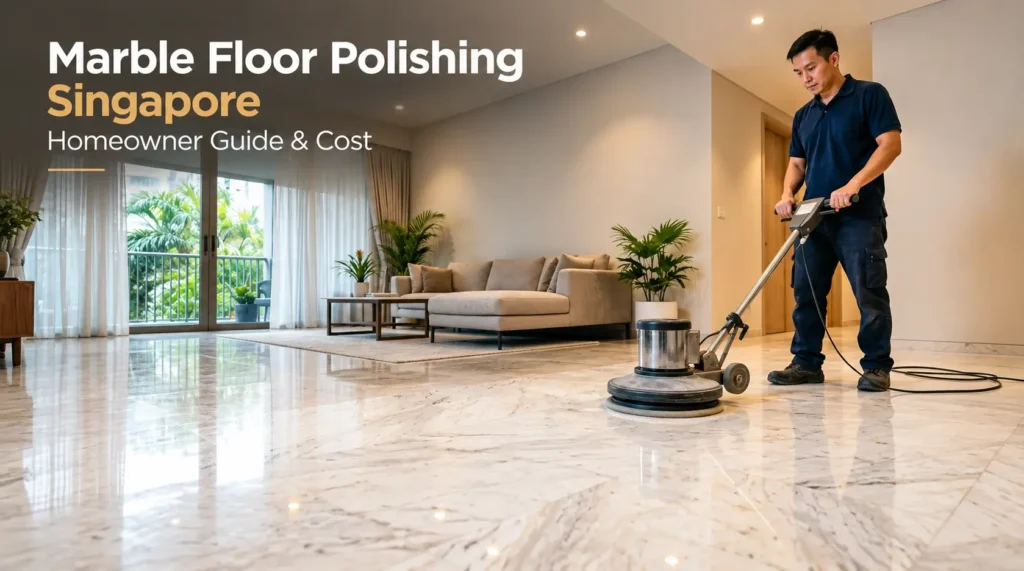
Your marble floor still looks cloudy after mopping. Scratches catch the light near the sofa, and a pale ring beside the dining table refuses to disappear. Before paying for restoration, you need to know whether the problem is dirt, surface damage or something polishing cannot fix.
This marble floor polishing Singapore guide explains treatment options, published local prices, quotation checks and aftercare so you can choose appropriate work rather than simply buy the cheapest promise of shine.
Marble floor polishing restores a worn marble surface through appropriate abrasion and finishing. Published Singapore prices range from about S$1–S$1.50 per square foot for advertised standard polishing to S$1.80–S$4.80 for more involved refinishing. Minimum charges, repairs and sealing can change the total; request an itemised quotation after inspection.
What does marble floor polishing actually do?
Marble polishing refines the stone’s surface to improve its finish and reflection. Professional restoration may combine abrasives, including diamond pads, with polishing compounds. The necessary steps depend on the marble, existing finish and depth of damage.
It is not simply a stronger cleaning service. Cleaning removes contamination; refinishing addresses damage to the surface itself.
For example, an acidic spill can leave an etch mark: a dull patch caused by a reaction with the stone. Scrubbing will not restore the missing polish. The Natural Stone Institute recommends professional refinishing or repolishing for etched areas.
How do polishing, honing, grinding and sealing differ?
| Treatment | Main purpose | Important limitation |
|---|---|---|
| Cleaning | Remove dirt, residue and appropriate surface contamination | Does not repair an etched finish |
| Grinding | Level or resurface stone using more aggressive abrasion | Not necessary for every dull floor |
| Honing | Refine the surface before polishing or create a lower-sheen finish | Does not produce the same appearance as high-gloss polishing |
| Polishing | Develop the intended shine and surface clarity | Cannot guarantee removal of deep stains or structural defects |
| Impregnating sealer | Improve resistance to liquid absorption and staining | Does not make marble stain-proof |
Marble floor grinding and honing may be part of a restoration package, but not every floor needs the full sequence. Ask the contractor to explain the purpose of each proposed stage. Sealing is a separate protection decision, not a substitute for polishing.
How much does marble floor polishing Singapore cost?
There is no single standard price. Published local advertisements use different scopes, minimum areas and charging methods, so compare the work included not just the headline rate.
| Published example | Advertised price | Qualification |
|---|---|---|
| Flooring Hero standard marble polishing | S$1–S$1.50 per sq ft | Advertised minimum of 500 sq ft |
| Longlong grinding and polishing | S$2 per sq ft | Gum grouting and sealer listed separately |
| Mr Wood Varnish refinishing guide | S$1.80–S$3.50 per sq ft | Listed for 500–1,000 sq ft |
| Same guide, larger-area category | S$2–S$4.80 per sq ft | Listed for 1,000–2,000 sq ft |
These are provider-published examples, not a measured market average or guaranteed current offers. Confirm rates, inclusions, minimum charges and GST treatment before booking; the Mr Wood Varnish guide is explicitly dated 2025.
Why does the price vary?
Your marble floor polishing cost in Singapore can change with:
- Floor condition and the amount of resurfacing required.
- The measured marble area rather than the property’s total floor area.
- Stain treatment, crack filling or joint repairs.
- Furniture movement and access restrictions.
- Edge work, protection and cleanup.
- Whether sealing is included or optional.
Local providers specifically identify damage, treatment method, accessibility and additional repairs as pricing factors. A lower marble polishing price per square foot may cover less work rather than represent better value.
What would a realistic quotation calculation look like?
Consider an illustrative 600 sq ft living and dining area:
- Contractor A quotes S$2 per sq ft: S$1,200 before extras.
- Contractor B quotes S$2.50 per sq ft: S$1,500 before extras.
Neither is automatically preferable. If Contractor B includes necessary joint repairs and protection that Contractor A charges separately, the final comparison could change.
These calculations are examples, not actual quotations. Ask both contractors to price the same scope.
Does your floor need polishing, stain treatment or repair?
Start by identifying the problem. Different-looking marks can require different treatments.
Is the cloudy patch residue or etching?
Clean a small area with an appropriate neutral stone cleaner, rinse and dry it. Cleaner residue can cause streaks or a film. If the patch remains dull particularly after contact with citrus, vinegar or another acid it may be etching rather than dirt.
Do not test the diagnosis with stronger acidic cleaners. They can worsen the surface damage.
Can polishing remove scratches?
Marble floor scratch removal depends on scratch depth. Professional resurfacing can address surface damage, but deeper scratches and nicks may require repair and repolishing rather than a light finishing pass.
Ask the contractor to identify marks likely to remain before approving the job.
Can polishing remove stains?
Not reliably on its own. Marble floor stain removal requires identifying the staining substance and selecting an appropriate treatment. A poultice a treatment used to draw staining material from stone may be needed. Deep rust staining can be particularly difficult and sometimes permanent.
What about cracks or recurring white powder?
Report cracks and recurring powder before requesting cosmetic work. The Natural Stone Institute identifies white powdery efflorescence as mineral deposits associated with moisture moving through stone; persistent cases require investigation of the moisture source. Polishing alone does not resolve that cause.
The key distinction: diagnosis should determine the treatment, not the other way around.
What happens during professional marble floor restoration?
A suitable marble floor restoration Singapore service should explain its proposed sequence. Not every project needs every step.
- Inspect and document the floor. Identify the stone, existing finish, scratches, stains and repairs.
- Agree on the scope. Confirm treated areas, exclusions and the intended finish.
- Protect adjacent surfaces. Establish access routes and responsibility for furniture movement.
- Complete necessary repairs. Address agreed joint filling, chips or other repairable defects.
- Grind or hone where required. Refine damaged areas using a suitable abrasive sequence.
- Polish and clean. Develop the agreed finish and remove process residue.
- Seal if appropriate. Follow the selected product’s application and curing requirements.
- Inspect together. Review the result and obtain written aftercare instructions.
Local restoration descriptions include grinding, honing, polishing, buffing and optional sealing; the actual combination should follow the floor assessment.
Diamond marble polishing refers to using diamond abrasives to refine the surface. The phrase alone does not tell you how much preparation, edge work or repair is included. Ask for the full method and expected limitations, not just a product or machine name.
How should you prepare your home?
Before the appointment, agree on a practical access plan:
- Identify who moves sofas, dining tables and fragile items.
- Photograph existing chips, cracks and adjacent finishes.
- Ask how skirting, cabinetry and nearby flooring will be protected.
- Confirm water, electricity and equipment-access requirements.
- Arrange a safe route for household members and pets.
- Ask about cleanup, slurry collection and waste removal.
- Check applicable building-management requirements before scheduling.
For a condominium, ask management whether contractor registration, lift protection or work-hour restrictions apply. Treat these as property-specific checks, not universal rules.
Request separate timings for the work itself, safe foot traffic, furniture replacement and wet cleaning. Do not assume they are interchangeable, particularly if a sealer or repair product is used; follow its manufacturer’s instructions.
How do you compare marble polishing contractors fairly?
Send the same photographs, approximate area and list of concerns to each provider. Then ask for a written quotation covering:
- Measured treatment area and minimum charge.
- Exact preparation and finishing stages.
- Included repairs and stain treatments.
- Furniture handling and surface protection.
- Sealer product, if proposed.
- Exclusions, GST treatment and payment terms.
- Expected completion and reopening times.
- Procedure for reviewing defects or uneven results.
What should you ask about the finished appearance?
Ask: “What improvement is realistic for this particular floor?”
A useful answer distinguishes achievable improvements from uncertain outcomes. For heavily stained or previously treated stone, request a discreet test area where practical.
Agree whether the goal is a high-gloss or lower-sheen finish. Honing and polishing produce different appearances, so “make it look new” is too vague to serve as an acceptance standard.
For comparing marble polishing Singapore services, a clear scope is more valuable than an unsupported promise of a flawless finish.
What do practical homeowner scenarios look like?
These hypothetical examples show how the decision changes with the problem.
Scenario 1: Dull walkways, otherwise sound marble
A homeowner notices wear along the main walking route but no obvious staining or damaged joints. The sensible starting point is an assessment for appropriate refinishing not automatically the most extensive grinding package.
Scenario 2: A pale ring beside the dining table
A spill leaves a dull ring without obvious discolouration. This is consistent with etching, although inspection should confirm it. The useful question is whether local refinishing will blend acceptably with the surrounding finish, not which cleaner is strongest.
Scenario 3: Brown marks beneath a planter
A darker mark may require stain identification and targeted treatment before polishing. If metal-related staining is involved, complete removal may not be possible. Obtain realistic expectations before authorising whole-room restoration.
What common mistakes should homeowners avoid?
- Comparing unlike packages. Basic polishing and extensive restoration are not equivalent.
- Treating every mark as a stain. Etching is surface damage, not simply absorbed colour.
- Using vinegar or acidic bathroom cleaners. These can etch marble.
- Expecting sealing to repair dullness. Impregnators improve stain resistance rather than restore polish.
- Requesting aggressive grinding without a reason. Ask what damage makes it necessary.
- Accepting guaranteed stain removal without assessment. Some deep stains remain difficult or permanent.
Never mix cleaning chemicals. In particular, bleach and ammonia can produce toxic gas. For unfamiliar stain treatments, seek a stone specialist rather than experiment with concentrated household chemicals.
What are the best practices for marble floor maintenance after polishing?
Protect the restored finish by reducing grit, residue and prolonged spill contact.
- Dust-mop frequently with a clean, non-treated mop.
- Place suitable entrance mats to intercept abrasive dirt.
- Use a neutral cleaner approved for natural stone.
- Follow dilution instructions; excess cleaner can leave film.
- Rinse as directed and dry the floor.
- Blot spills promptly rather than spreading them.
- Check vacuum wheels and attachments for damage.
Is marble floor sealing in Singapore always necessary?
No. The Natural Stone Institute notes that some stones do not require sealing. Where appropriate, an impregnating sealer makes the stone more stain-resistant, not stain-proof. Ask the contractor to justify the recommendation for your marble and intended use.
Avoid a fixed resealing calendar without product-specific advice. The stone supplier or sealer manufacturer should guide maintenance and reapplication.
Frequently asked questions
How often should marble floors be polished?
Polish when the floor’s condition warrants it, rather than following an automatic annual schedule. Look for persistent dullness, etched areas or scratches after suitable cleaning. Traffic, abrasive grit and maintenance affect wear. Ask a restorer whether targeted treatment is sufficient before committing to full-area refinishing.
How long does marble floor polishing take?
The duration depends on area, condition, repairs and the treatment sequence. Obtain a project-specific schedule rather than relying on a universal one-day promise. Ask when you can walk on the floor, replace furniture and resume wet cleaning; applied sealers or repair products may have separate restrictions.
Can I polish marble floors myself?
Routine cleaning is suitable for homeowners, but deeper scratches, etched finishes and unfamiliar stains merit professional advice. A small mark may need a different treatment from general dullness. The Natural Stone Institute recommends professional repair and repolishing for deeper scratches and professional assistance with difficult stone-care problems.
Will sealing stop lemon juice from damaging marble?
Do not rely on an impregnating sealer to prevent acid damage. Marble’s calcium-carbonate content is acid-sensitive, while impregnators primarily improve resistance to staining. Wipe up acidic spills promptly and use appropriate protection around drinks or food. Sealing does not eliminate the need for careful daily maintenance.
Can one damaged marble tile be polished separately?
Ask for an assessment before assuming an entire room needs treatment. A professional may refinish an etched area, but the proposed scope should explain how the repaired finish will relate to the surrounding floor. Request a test area where practical and agree on acceptable appearance before proceeding.
Why is a small polishing job expensive per square foot?
A minimum charge can make the effective rate higher for a small area. Published Singapore pricing includes minimum-area offers and separate small-area price bands. Ask whether your quotation uses measured area, a minimum billable area or a fixed project fee, and compare the final payable totals.
Conclusion: choose the right scope before choosing the price
A successful restoration starts with knowing what needs fixing. Separate residue from etching, scratches from deeper damage, and polishing from stain treatment or sealing.
Before booking, obtain an itemised quotation, agree on realistic results and confirm aftercare. To request an assessment, prepare an approximate marble area, clear photographs and a short description of the problem. That gives the contractor a better starting point than a request for “the cheapest polishing rate”.