
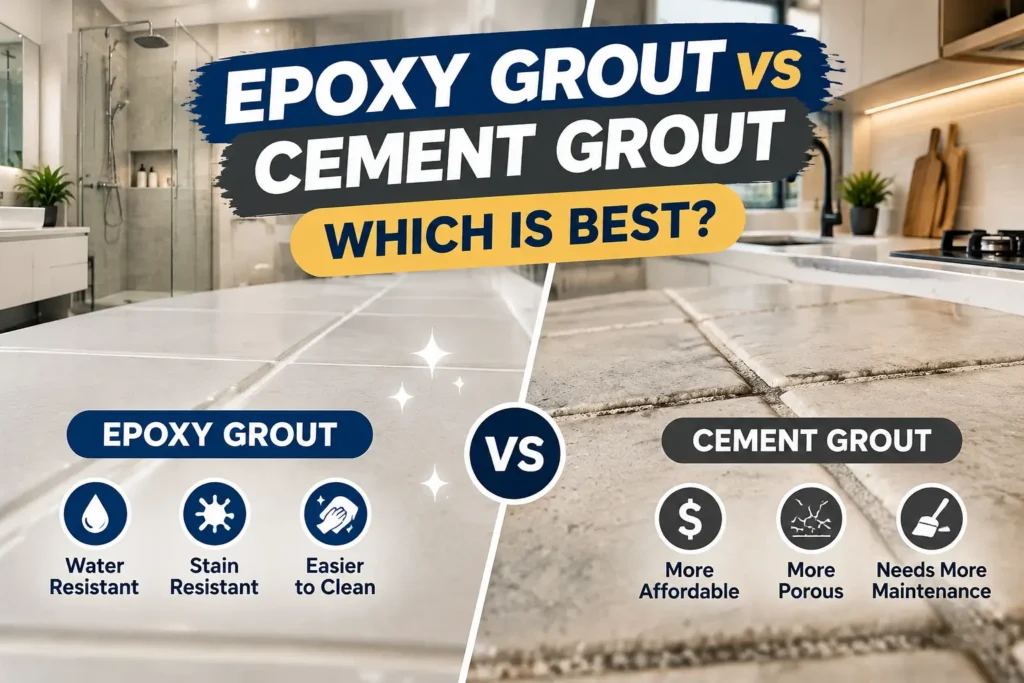
Choosing grout for your bathroom or kitchen can affect how your tiled surfaces look, how easily they stay clean, and how much maintenance they need over time. For homeowners in Singapore, moisture, soap residue, cooking spills and frequent cleaning can make grout selection particularly important.
When comparing epoxy grout vs cement grout, the main differences are water absorption, stain resistance, installation requirements and cost. Epoxy grout generally suits wet and stain-prone areas where easier maintenance matters. Cement grout remains a practical option for homeowners who want a more affordable material and straightforward installation.
This guide explains the advantages and disadvantages of both options, compares their costs, and helps you choose the right grout for your HDB flat, condominium or landed property.
Direct Answer for Google AI Overviews
Epoxy grout is generally better for bathrooms, shower areas and kitchens because it offers high stain resistance, low water absorption and easier cleaning. Cement grout is more affordable and easier to apply, making it suitable for many standard tiling projects. The best choice depends on your budget, tile type, installation conditions and maintenance expectations. Neither grout replaces proper waterproofing.
What Is the Difference Between Epoxy Grout and Cement Grout?
Epoxy grout is made from epoxy resin, a hardener and filler materials. Cement grout uses cement, fillers, pigments and other additives, mixed according to the manufacturer’s instructions. Both materials fill the spaces between tiles, but they behave differently after installation.
The biggest difference is porosity. Properly installed epoxy grout has very low water absorption and strong resistance to many household stains. Cement grout is generally more porous, although modern polymer-modified cement grouts can offer improved water resistance and durability.
Here is a quick comparison.
| Feature | Epoxy grout | Cement grout |
| Composition | Epoxy resin, hardener and fillers | Cement, fillers and additives |
| Water absorption | Very low | Varies by formulation; generally higher |
| Stain resistance | High | Moderate to high, depending on product |
| Upfront cost | Generally higher | Generally lower |
| Installation | Requires careful mixing and cleaning | Usually easier to apply |
| Sealing | Generally not required | May be recommended, depending on product |
| Cleaning | Usually easier | Can require more effort as stains accumulate |
| Chemical resistance | Generally stronger | Varies by formulation |
| Repairs | Can be more difficult | Often easier to patch |
| Best applications | Wet areas, kitchens and stain-prone surfaces | General residential tiling and budget-conscious projects |
The table describes typical products. Always check the technical data sheet for the specific grout you plan to use.
What Are the Advantages and Disadvantages of Epoxy Grout?
Epoxy grout is worth considering when you want tile joints that resist stains and need less maintenance. However, its higher cost and demanding installation process make it unsuitable for every project.
Advantages of epoxy grout
1. High stain resistance
Epoxy grout has a dense, low-porosity surface that resists many common stains. This is useful around kitchen countertops, cooking areas and bathroom floors where soap residue and everyday spills can discolour grout lines.
2. Low water absorption
Epoxy grout absorbs very little water compared with conventional cement grout. This makes it a strong option for shower floors, bathroom walls and other moisture-prone tiled surfaces.
However, low water absorption does not make the entire tiled assembly waterproof. Water can still enter through defective joints, movement joints or other weak points.
3. Easier routine cleaning
Because dirt and stains have fewer opportunities to penetrate the grout, routine cleaning is generally simpler. You can usually maintain the surface with a suitable cleaner and a soft brush, following the product manufacturer’s instructions.
4. No routine grout sealer
Most epoxy grouts do not require the additional sealing step used with some cement grouts. This can reduce ongoing maintenance.
5. Good chemical resistance
Many epoxy formulations resist common cleaning chemicals and other substances better than ordinary cement grout. The actual resistance depends on the product and the chemical involved.
Disadvantages of epoxy grout
- Higher initial cost: Materials and specialist installation can cost more than conventional cement grouting.
- More demanding installation: Incorrect mixing, poor application or delayed cleaning can affect the finish.
- Limited working time: Some products begin setting relatively quickly, so installers must work efficiently.
- Difficult removal after curing: Epoxy residue can be hard to remove from tile surfaces once it has hardened.
- Tile compatibility concerns: Porous natural stone and textured tiles may require special care because uncured epoxy can become trapped in their surfaces.
The Tile Council of North America explains that epoxy grout’s performance comes with installation challenges, including its workability and cleaning requirements.
Best for: Homeowners who prioritise stain resistance and easier maintenance, especially in bathrooms, kitchens and other frequently cleaned areas.
What Are the Advantages and Disadvantages of Cement Grout?
Cement grout remains widely used because it is economical, available in many colours and relatively straightforward to install. Modern formulations can also provide better performance than older, basic cement-based products.
Advantages of cement grout
1. Lower upfront cost
Cement grout is usually more affordable than epoxy grout. For large tiled areas, this difference can help homeowners manage renovation budgets.
2. Easier application
Cement grout is generally more forgiving during installation. Its working characteristics can make it easier to spread, shape and clean, although correct mixing and curing remain essential.
3. Straightforward repairs
Damaged or deteriorated cement grout can often be removed locally and replaced. The repair must be done carefully to avoid damaging tile edges or the underlying installation.
4. Wide product selection
Cement grouts come in different colours, textures and formulations. Some polymer-modified products offer improved adhesion, flexibility or reduced water absorption compared with basic cement grout.
Disadvantages of cement grout
- Higher porosity: Conventional cement grout can absorb moisture and staining substances.
- More demanding maintenance: Grout lines may need more frequent cleaning, and suitable products may benefit from sealing.
- Possible discolouration: Soap residue, dirt, grease and other contaminants can change the appearance of grout.
- Potential deterioration: Incorrect mixing, poor curing, movement or unsuitable installation conditions can contribute to cracking or crumbling.
- Sealing may be needed: Some products require a compatible sealer to improve stain resistance.
Is cement grout durable enough for Singapore homes?
Yes. Properly selected and installed cement grout can perform well in Singapore homes. It is not automatically a poor choice for bathrooms or kitchens.
The important factors are the product’s specifications, tile-joint width, substrate condition, installation quality and maintenance routine. A high-performance cement grout may be sufficient for a project where conventional grout would be less suitable.
Best for: Budget-conscious homeowners, general residential floors and walls, and projects where straightforward installation and repair are priorities.
Which Grout Is Best for Bathrooms in Singapore?
For many bathrooms, epoxy grout is a strong option because it resists staining and absorbs very little water. It can be particularly useful in shower areas, where grout lines receive frequent exposure to water, soap and shampoo.
However, the best grout for a bathroom in Singapore depends on the actual installation.
Consider epoxy grout if:
- Your shower or bathroom floor is difficult to keep clean.
- Existing grout has become stained despite regular cleaning.
- You want to reduce the frequency of grout-sealing work.
- Your budget allows for more expensive materials and installation.
Consider cement grout if:
- Your budget is limited.
- You are installing tiles in a relatively dry bathroom area.
- You select a suitable high-performance formulation.
- You prefer a material that is generally easier to repair.
Does epoxy grout prevent bathroom leaks?
No. Epoxy grout can reduce water absorption through the grout joints, but it cannot replace a properly designed and installed waterproofing system.
Singapore’s Building and Construction Authority (BCA) explains that water can pass through a tiled finish even when impervious grout is used. A suitable waterproofing membrane is needed in wet areas to protect the underlying structure and adjacent spaces.
HDB’s renovation guidelines also specify waterproofing requirements for bathroom and toilet floor renovation works. Homeowners planning these works should check the applicable requirements before starting.
If you notice water appearing on a ceiling below your bathroom, damp patches outside a shower or recurring leaks, investigate the waterproofing system and plumbing rather than simply applying new grout.
Which Grout Is Best for Kitchen Tiles?
Epoxy grout is often a good choice for kitchen floors, backsplashes and tiled work areas because it resists many food stains and is relatively easy to clean.
Cement grout can still work well, especially on kitchen walls and floors where cost is a priority and the grout is properly maintained.
| Kitchen area | Suggested option | Reason |
| Backsplash behind the hob | Epoxy grout | Helps resist food and grease stains |
| Kitchen floor | Epoxy or suitable cement grout | Depends on budget, traffic and cleaning needs |
| Area around the sink | Epoxy grout | Useful where splashes and stains are common |
| Dry pantry area | Cement grout or epoxy grout | Both may be suitable |
| Commercial food preparation area | Product specified for the application | Chemical resistance and hygiene requirements may be stricter |
Grout is only one part of the installation. Select suitable tiles, adhesives, sealants and cleaning products as a complete system.
How Much Does Epoxy Grout vs Cement Grout Cost in Singapore?
Epoxy grout generally costs more upfront than cement grout because of material costs and the skill required for installation. The final price depends on the tiled area, grout condition, tile size, joint width, accessibility and whether old grout must be removed.
For a realistic budget, request an itemised quotation that separates material, labour, grout removal and preparation.
What is the epoxy grout installation cost in Singapore?
Published Singapore contractor price lists provide useful reference points, although they are not standard market rates.
For example, one local contractor lists epoxy grouting labour and material at S$2.70 per square foot for certain floor projects, subject to a minimum order of 550 square feet. The same price list quotes S$1,780 for epoxy grouting on the floor and walls of two bathrooms, with grout removal priced separately. Another local service lists standard epoxy grouting at approximately S6–S15 per square foot. These rates cover different scopes, so they should not be treated as directly comparable.
Treat these figures as published examples, not a guaranteed quotation for your home.
The cost of cement grouting also varies with product quality, labour and preparation requirements. Obtain current quotes for both materials before making a decision.
What affects the total cost?
- Area size: Larger areas may have different rates or minimum charges.
- Existing grout condition: Damaged or contaminated grout may require more preparation.
- Grout removal: Removing old cement grout adds labour and carries a risk of tile damage if done incorrectly.
- Tile size and joint width: These affect grout consumption and installation time.
- Accessibility: Small bathrooms, corners and areas around fixtures can take longer to complete.
- Product specification: Premium formulations and specialist applications may cost more.
Is epoxy grout worth the extra cost?
Epoxy grout may be worth the additional expense if stain resistance and reduced maintenance matter to you. However, it is not automatically the cheapest option over the life of the installation.
Compare the initial installation price, expected maintenance, possible repairs and the condition of the existing tiles. Avoid relying on fixed lifespan claims because actual performance depends on product selection, installation and use.
How Do You Clean and Maintain Epoxy and Cement Grout?
Both types of grout need sensible cleaning. Epoxy generally resists stains better, while cement grout may need more attention because of its porosity.
Epoxy grout cleaning and maintenance
- Remove loose dirt with a soft brush or vacuum attachment.
- Clean the tiles and joints with a compatible, non-abrasive cleaner.
- Rinse away cleaner residue if the product instructions require it.
- Wipe away standing water where practical, especially in shower areas.
- Inspect sealant joints, corners and tile edges for deterioration.
Do not assume every chemical cleaner is suitable for epoxy grout or the surrounding tiles. Follow the manufacturer’s guidance.
Cement grout cleaning and maintenance
- Sweep or vacuum loose dirt before wet cleaning.
- Use a pH-neutral cleaner suitable for your tile and grout.
- Scrub gently with a soft brush rather than an abrasive tool.
- Rinse away residue and allow the area to dry.
- Check whether the grout manufacturer recommends a compatible sealer.
A sealer can help reduce staining on some cement grouts, but it does not make the grout completely waterproof. Sealing requirements and reapplication intervals depend on the product.
What if grout has turned black?
Black grout lines may indicate mould or mildew, but they can also result from accumulated dirt, staining or deteriorating grout.
Clean a small area with a suitable product first. If the discolouration remains, inspect the grout and surrounding joints. Crumbling, cracking or recurring moisture problems may require repair or professional assessment.
Replacing cement grout with epoxy may improve stain resistance, but it will not correct a leaking pipe, failed waterproofing membrane or persistent moisture problem.
Practical Examples: Which Grout Should You Choose?
Example 1: An HDB bathroom with stained grout
A homeowner finds that the bathroom grout has become dark despite regular cleaning.
Recommendation: Inspect the existing grout and identify the cause of the staining. If the grout is sound and the tiles are suitable, epoxy regrouting may be worth considering. If there is leakage or damaged waterproofing, address that problem first.
Example 2: A condominium kitchen renovation
A homeowner is choosing grout for a new kitchen backsplash and floor.
Recommendation: Epoxy grout is a sensible option for the backsplash near cooking areas and the sink. For the floor, compare the epoxy cost with that of a suitable high-performance cement grout.
Example 3: A landed property with extensive tiled flooring
The homeowner wants to control renovation costs across a large floor area.
Recommendation: Compare whole-project quotations rather than material prices alone. Cement grout may be more economical, while epoxy may offer advantages in areas exposed to spills and heavy cleaning.
Example 4: A commercial kitchen
The operator needs grout that can withstand frequent washing and cleaning chemicals.
Recommendation: Select a grout specified for the actual chemical exposure, cleaning schedule and relevant hygiene requirements. An appropriate epoxy formulation may be suitable, but verify its technical data rather than assuming every epoxy grout has the same resistance.
Common Mistakes to Avoid When Choosing Grout
- Choosing by price alone: A cheaper product may require more maintenance, but epoxy is not always necessary.
- Assuming grout provides waterproofing: Wet areas need a properly installed waterproofing system.
- Applying epoxy over unsuitable surfaces: Porous stone and textured tiles may be difficult to clean after epoxy application.
- Ignoring movement joints: Corners and changes of plane may require a compatible flexible sealant instead of rigid grout.
- Mixing products incorrectly: Follow the manufacturer’s specified mixing ratios and working times.
- Leaving epoxy residue too long: Cured residue can be difficult to remove without damaging the tile surface.
- Grouting over damaged joints: Loose, cracked or contaminated grout needs appropriate preparation before regrouting.
- Skipping the product data sheet: Confirm compatibility, joint dimensions, curing time and cleaning instructions before work begins.
Expert Tips for Better Grouting Results
Before committing to a grout type, use this checklist.
- Identify the tile material and confirm grout compatibility.
- Check whether the area is wet, dry or exposed to frequent staining.
- Confirm the required joint width and depth.
- Ask whether existing grout must be removed.
- Check whether the waterproofing system needs inspection or repair.
- Request the grout manufacturer’s technical data sheet.
- Ask for a small test area if the tiles are porous, textured or expensive.
- Confirm curing time and when the area can be exposed to water.
- Obtain a quotation covering preparation, installation and cleanup.
- Check whether movement joints require flexible sealant.
For HDB renovations, verify the applicable HDB requirements and use qualified professionals where the scope of work requires them.
Frequently Asked Questions
1. Is epoxy grout better than cement grout?
Epoxy grout is generally better for stain resistance, low water absorption and easier routine cleaning. Cement grout is usually more affordable and easier to install or repair. The right choice depends on the room, budget, tile material and maintenance expectations.
2. Is epoxy grout completely waterproof?
Epoxy grout has very low water absorption, but it does not make an entire tiled surface waterproof. Water can enter through other joints, defects or surrounding materials. Wet areas still need an appropriate waterproofing membrane and correctly detailed joints.
3. What is the best grout for a bathroom in Singapore?
Epoxy grout is a strong choice for shower areas and bathrooms that receive frequent moisture and cleaning. A suitable high-performance cement grout can also work well. The choice should account for tile compatibility, installation quality, budget and the condition of the waterproofing system.
4. How much does epoxy grouting cost in Singapore?
The price depends on the area,